

You are in front of your computer, one shop tab open, another with customer reviews, and a very simple question is holding you back. Sublingual spray, drops, or capsules? When discovering mycotherapy, one quickly gets the impression that everything is the same, whereas the difference often lies in the composition, the format, and the context of use.
In France, you must start from a clear idea: functional mushrooms are not medicinal plants. Mycotherapy products fall under the status of food supplements, with requirements for declaration, labeling, and caution that do not overlap with those of plants or drugs framework for food supplements in France. It is this framework that helps to read products methodically, without over-interpreting a bottle or minimizing its limitations.
Table of contents
- Understanding what mycotherapy is today
- The traditional roots of mycotherapy
- The active compounds that make mushrooms interesting
- The five key species and their common uses
- Choosing between sublingual spray, drops, and capsules
- What clinical studies actually say
- Common misconceptions and frequent errors to avoid
- How to choose your supplement in practice
Understanding what mycotherapy is today

A bottle of mycotherapy might seem simple at first glance. However, one must read the label as one would read a technical data sheet, starting with three concrete markers: the exact species, the part used, and the production process. These elements already say a lot about what the product can, or cannot, provide.
A wellness practice, not a parallel medicine
In France, the starting point is regulatory. Products sold in mycotherapy fall under the framework of food supplements framework for food supplements in France, which requires precise labeling and prevents them from being presented as drugs. The ministry specifically points out that the label must indicate the recommended daily portion, the limit not to be exceeded, and the idea that a supplement does not replace a varied and balanced diet.
Another useful habit is to look beyond the trade name. Anses (the French Agency for Food, Environmental and Occupational Health & Safety) has highlighted that the mere idea of a "positive list" of mushrooms is not enough to guarantee safety in use, because the species, the preparation, and the exposure all count in the evaluation Anses opinion on mushrooms used in supplements. Two products with the same name can therefore be very different. This is particularly true for Reishi, Lion's Mane, Cordyceps, Chaga, and Shiitake.
Simple landmark: if the packaging implies that it cures, treats, or replaces medical advice, you are already stepping out of the correct reading framework.
Reading a product then becomes clearer. One first looks at the identity of the mushroom, then the part selected, then the way it was processed. It is this method that helps to distinguish a correctly presented supplement from a simple marketing gimmick.
The traditional roots of mycotherapy
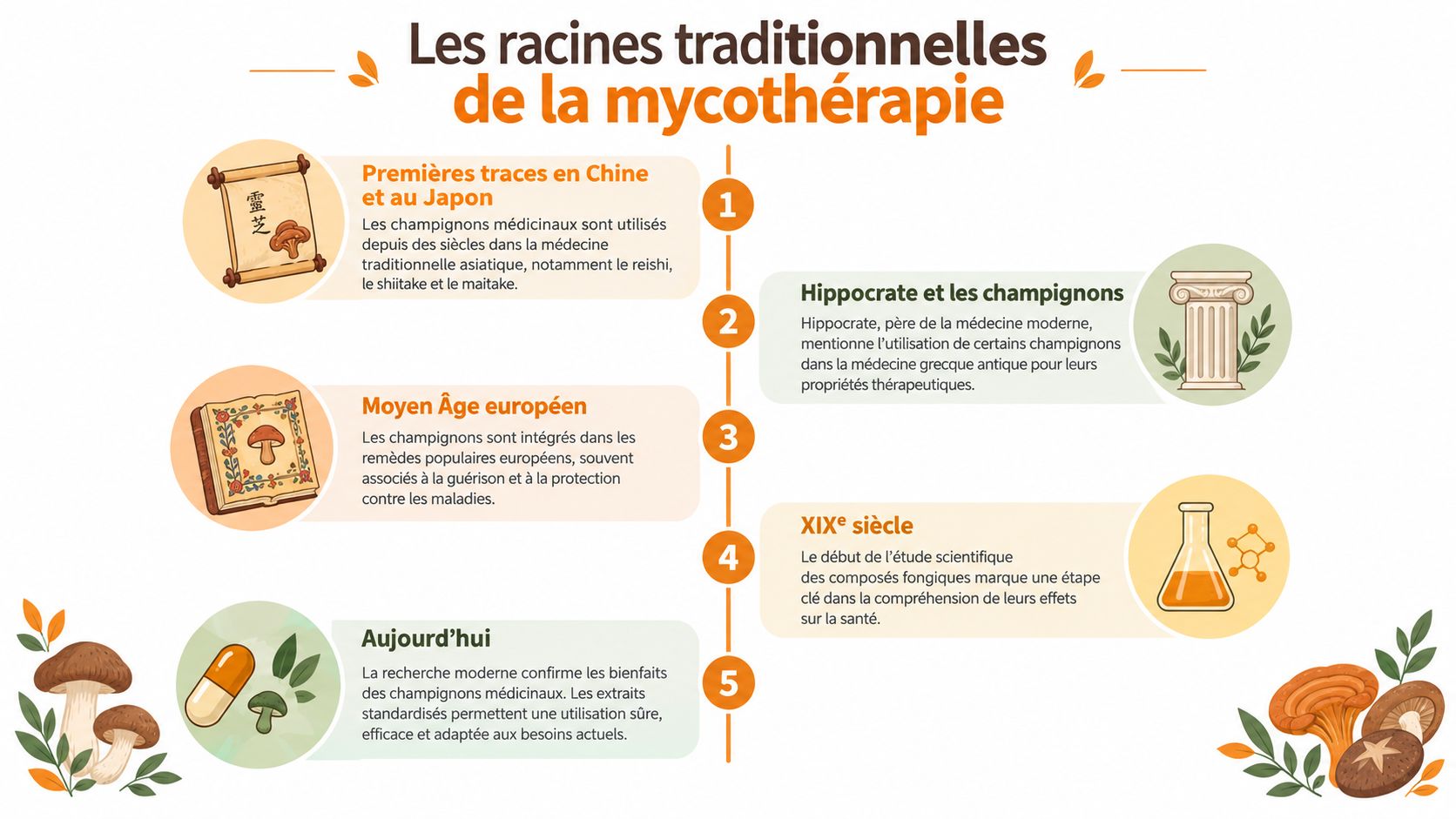
The current reputation of functional mushrooms does not come from nowhere. In Asia, some of them have long been integrated into traditional health practices, especially in China and Japan, with a prominent place for Reishi and Cordyceps. Their status was often prestigious, sometimes reserved for scholarly uses, which contributed to their aura even in modern formulations.
From traditional use to a subject of study
The shift toward contemporary research occurred when science began to take an interest in their compound families, notably polysaccharides and beta-glucans. This shift is important because it changes the question asked. One no longer asks only "what was this mushroom used for in tradition?", but also "what compounds does it contain, and what do we actually see in humans?"
This nuance avoids two common errors. The first is believing that ancient use is enough to prove a current effect. The second is to reject what comes from tradition in its entirety, even though certain compounds have indeed been studied. Both attitudes oversimplify.
The reader therefore benefits from remembering one very concrete thing. Modern mycotherapy relies on a traditional heritage, but it can only be understood with today's tools, i.e., analysis of composition, standardization of extracts, and critical reading of human trials.
The historical interest of a mushroom does not yet tell what a given extract will do in a given bottle.
It is precisely this link between tradition and modern control that makes the subject useful. It allows for an understanding of why species, part used, and extraction process are discussed so much when comparing two products.
The active compounds that make mushrooms interesting
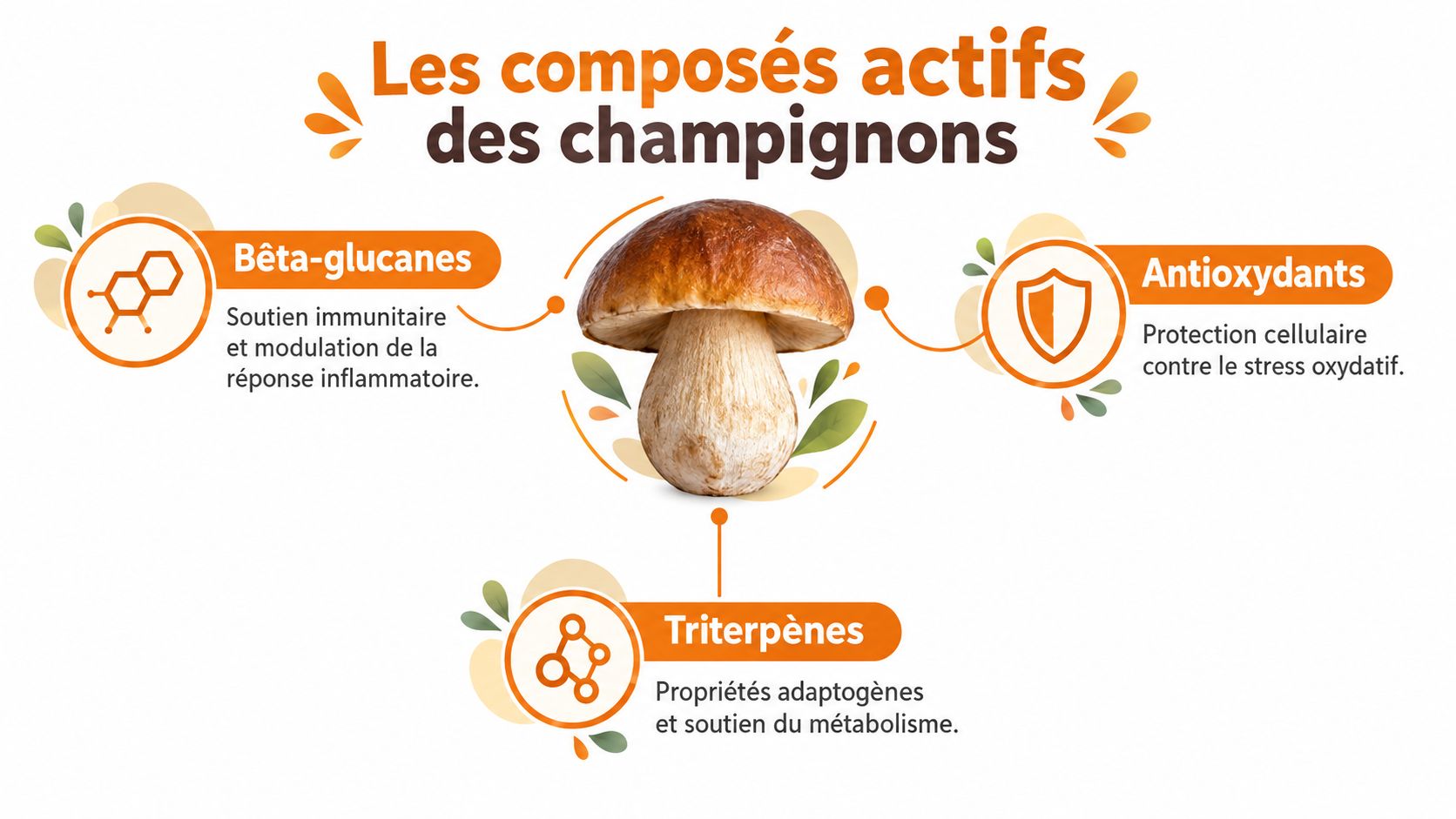
A functional mushroom acts less like a single ingredient than like a small chemical factory. Depending on the species, it can concentrate beta-glucans, triterpenes, antioxidant compounds like ergothioneine, and other families as well. The key point is that these molecules do not have the same profile or the same interest depending on the context.
Three families to know without mixing them up
Beta-glucans are often at the center of discussions on immunity. One can imagine them as a network structure, derived from the mushroom's cell wall, which the body recognizes in a particular way. Their interest depends as much on their nature as on their presentation, because their solubility and extraction significantly alter what is actually found in a supplement. To delve deeper into this question of bioavailability, a useful reference is this guide on beta-glucans and mushrooms.
Triterpenes are primarily associated with Reishi. They are often described for their bitterness, but they are primarily useful markers for distinguishing one formulation from another. Here again, the final quantity depends on the part of the mushroom used and the extraction solvent. An extract is therefore not only "more concentrated"; it is sometimes simply more oriented toward a specific family of molecules.
Ergothioneine attracts attention because it is being studied as an antioxidant compound. It serves here to remind us that a mushroom cannot be reduced to a single mechanism. Some formulas seek an immune profile, others a more antioxidant profile, and others a combination of active families.
Why two identical-looking products are not the same
Two "Reishi-based" bottles can differ significantly. One might contain the fruiting body, the other the mycelium. One might be water-extracted, the other with a different solvent. One might display a 10:1 ratio without providing markers, the other might document its dry matter and its compounds of interest.
Practical rule: if the label says nothing about the exact species, the part used, and the process, you are not really comparing two products; you are comparing two promises.
The five key species and their common uses
The heart of modern mycotherapy often holds in five names. Each refers to a species, a marker compound, and a dominant traditional use. Mixing them up is like talking about functional mushrooms as a single block, whereas French regulations and the reading of a label specifically require distinguishing the species, the part used, and the extraction process. This precision also helps not to confuse a medicinal plant, often regulated differently, with a mushroom-based supplement.
| Species | Marker compound | Dominant traditional use | Current level of evidence |
|---|---|---|---|
| Reishi | Triterpenes, polysaccharides | General support, vitality, long-standing traditional use | Heterogeneous human studies, mostly in disease contexts |
| Lion's Mane | Erinacines, hericenones, polysaccharides | Traditional cognitive support and modern interest for concentration | Real scientific interest, but evidence still limited |
| Cordyceps | Cordycepin, polysaccharides | Energy, endurance, vitality | Variable results depending on populations and protocols |
| Chaga | Polyphenols, melanins | Traditional use related to tone and endurance | Very limited human data |
| Shiitake | Beta-glucans, cell wall compounds | Food mushroom associated with immune support | Interesting human data, but still targeted |
Reishi, Lion's Mane, and Cordyceps
Reishi is often associated with overall support. Its triterpenes serve as a benchmark for understanding why certain extracts are sought after more than others. Reading remains cautious, because human studies are mostly heterogeneous and located in specific contexts, not in a general promise of wellness.
Lion's Mane attracts people looking for support for cognition or concentration. Erinacines and hericenones remind us that we are talking about a molecular profile, not a "mushroom for the brain" in a simplistic sense. For the history and botany of the species, see the history, science, and botany of Lion's Mane. Expectations must remain measured, because scientific interest does not mean broad clinical validation.
Cordyceps is often placed in the category of energy and endurance. Its reputation is strong, but human response varies according to populations and protocols. As with a research file, the result here depends as much on the raw material as on the way it is prepared.
Chaga and Shiitake
Chaga concentrates polyphenols and melanins, but no significant human trial yet validates its traditional uses for tone. This limitation must be stated clearly, because an interesting chemical profile is not enough to conclude about an effect in humans.
Shiitake occupies a separate place because it is also a food mushroom. Its beta-glucans attract attention in the field of immunity, with interesting but still targeted human data. The right reflex is therefore to associate each species with its marker compounds, then to read the actual scope of the evidence before drawing a practical conclusion.
Choosing between sublingual spray, drops, and capsules
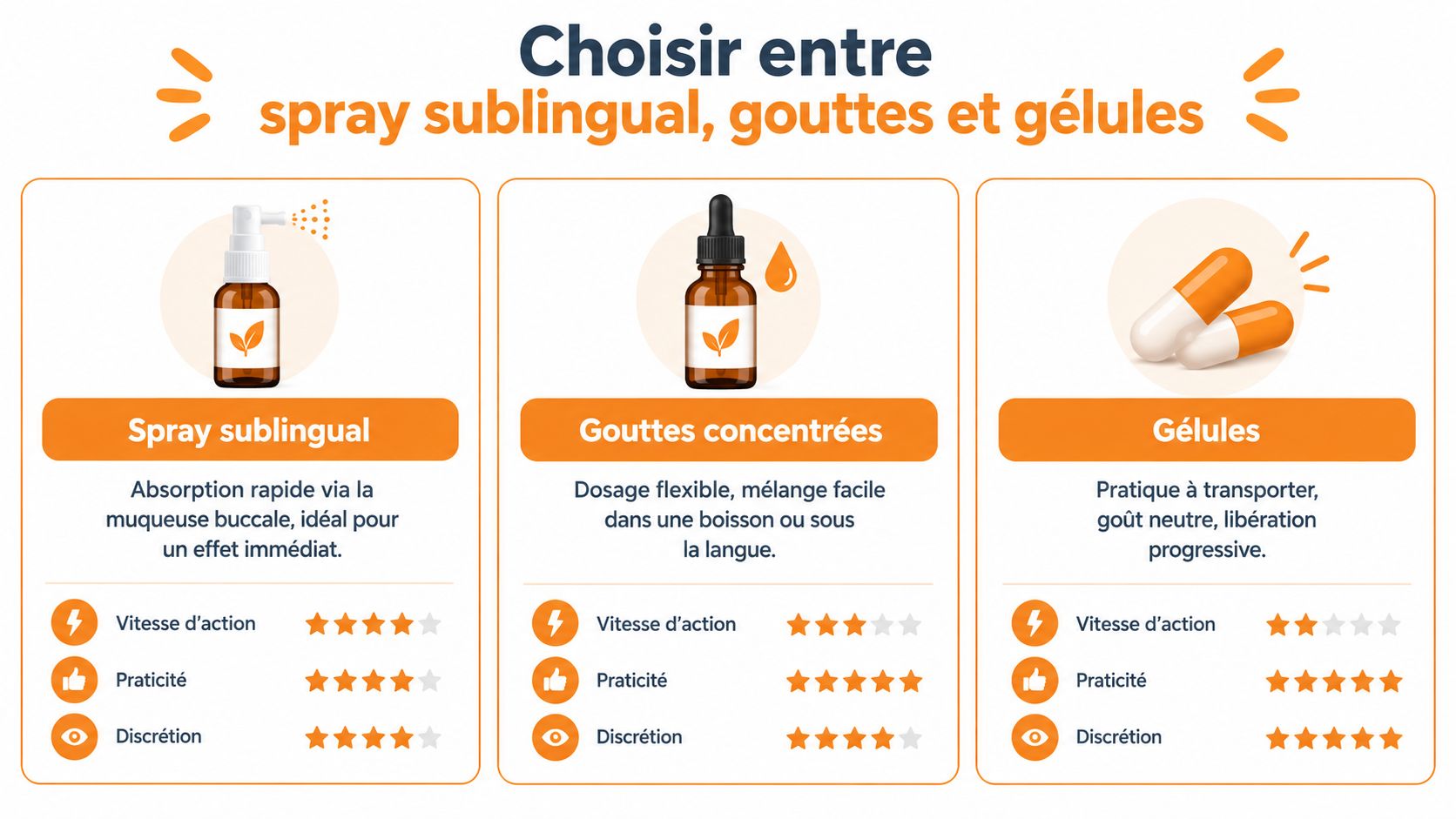
The format changes the experience as much as the formula. The same extract can become easier to integrate into daily life as a sublingual spray, more adaptable in drops, or more neutral in capsules. The right question is therefore not only "which is the strongest?" but "which is the most consistent with the dosage, regularity, and your comfort of use?". For a detailed comparison, see sublingual spray or capsules: which method to choose.
Three formats, three logics
A sublingual spray aims for rapid intake, with part of the absorption happening through the oral mucosa. It is well suited for people who do not like swallowing capsules or who want a simple action. Drops offer real flexibility because one can adjust the quantity more finely, provided the dropper is precise.
Capsules remain practical when one wants taste neutrality, easy transport, and standardized dosage. Powders can work in a dietary routine, but they are often less convenient for very regular use. The choice therefore depends on lifestyle as much as on the product itself.
Useful reading rule: if a format helps you stick to the planned intake, it is often better than a theoretically interesting format that is abandoned after three days.
The technical point to watch is the extraction ratio. A 10:1 is not, by itself, proof of active ingredient content. Ideally, one should know the species, the part used, the solvent, the batch, the dry matter, and, when relevant, analytical markers like beta-glucans or triterpenes.
For those looking for an example of product reading, Pure Croft France offers liquid supplements in sublingual sprays and concentrated drops based on functional mushrooms. This is a format that well illustrates this logic of reproducible dosage, without replacing the examination of technical data sheets and certificates of analysis.
What clinical studies actually say
The human literature on functional mushrooms does not tell a single story. It rather shows unequal levels of evidence depending on the species, the format, and the studied population. This is precisely why results must be read with patience.
Promising studies, unequal evidence
Reishi is primarily studied in supportive contexts, not as a general response to a common symptom. Lion's Mane is of interest in cognitive research, but trials remain small-scale. Cordyceps shows variable signals depending on the individuals studied, which prevents generalization to everyone.
Shiitake has an interesting human trial on immune markers, but it remains a single type of protocol with a specific dietary form. Chaga well illustrates the limit between activity observed in the laboratory and demonstration in humans. An extract can be chemically interesting without a solid clinical trial yet confirming it.
Serious clinical studies share a few common points. They use precise doses, follow durations long enough to be interpretable, and compare, whenever possible, to a placebo. However, many studies remain small, heterogeneous, or focused on a very specific population.
Key takeaway: "Studied" does not mean "proven," and "promising" does not mean "demonstrated."
The right approach is therefore to look at three things every time. Who was studied, for how long, and with what mushroom format? Without these three benchmarks, it is easy to overinterpret an abstract. With them, one better understands why certain products serve as supplements, while others do not go beyond the stage of a useful hypothesis.
Common misconceptions and frequent errors to avoid
Mycotherapy quickly attracts shortcuts. Correcting them calmly avoids unrealistic expectations and ill-informed purchases.
Five common confusions
- "Natural" means "medicine." In France, a mycotherapy product remains a food supplement, with its own framework and regulated claims.
- The higher the dose, the more effective it is. The right dose depends on the species, the type of extract, and the compound sought. A 500 mg 10:1 fruit body extract is not equivalent to 5 g of raw powder. Here, the number on the bottle does not say everything; the marker being tracked counts more.
- Capsules and liquid extracts are equivalent. They have neither the same convenience, nor the same mode of administration, nor necessarily the same dosage reproducibility. One format may be simpler to take, without being more informative about the formula.
- A mushroom renowned for an effect always provides it. Traditional uses provide leads, but they do not authorize a therapeutic claim. To situate what can be expected from a product, the list of plants and mushrooms helps place mycotherapy within its regulatory framework.
- Natural means risk-free. This is the most dangerous error. Certain situations require professional advice before any use, especially in case of medical treatment, chronic illness, pregnancy, or breastfeeding. The Anses nutrivigilance report reminds us that adverse effects also exist with products of natural origin.
The right reflex is not to be suspicious of everything. It is to distinguish between the species, the galenic form, and the situation of the person taking the supplement. This distinction changes the quality of the choice.
How to choose your supplement in practice
If you are hesitating in front of a shelf or a product sheet, keep a simple method. First, check the exact species in Latin, then the part used. A product based on the fruit body is not read like a mycelium-based product. Then look for the extraction process, the stated concentration, and a certificate of analysis for the batch, requested by email if necessary.
In practice, the right reflex consists of three actions. 1) Read the Latin name. 2) Look for the mention of fruit body. 3) Request documentary proof for the batch. This small routine avoids confusing a precise formula with a vague label.
The format also counts, but it doesn't say everything. A spray can be practical, a drop more modular, a capsule simpler to take. In France, a food supplement complies with a specific declaration and labeling framework.
If you are taking an anticoagulant or an immunosuppressant, if you are pregnant, breastfeeding, or have a chronic illness, seek medical or pharmaceutical advice before use. The Anses nutrivigilance report reminds us that adverse effects also exist with natural products.
Mycotherapy should therefore be chosen as one would choose a technical part, by looking at the species, the part, the process, and the person's context.
Created with Outrank tool
